Buying Guide
First-Time Buyer's Guide to Nova Scotia Real Estate
Buying your first home in Nova Scotia? Everything you need to know to make a confident, informed decision.

Nyssa Carter, REALTOR®
The Agency Halifax11 min read
Buying your first home is one of life's biggest milestones, and one of its most overwhelming. If you're looking at Nova Scotia, you've already made a great choice. The province offers a quality of life that larger markets can't match, at prices that still make homeownership achievable.
Here's my guide to navigating the process with confidence.
Step 1: Understand Your Budget
Before looking at a single listing, get clear on what you can afford. This means more than just the mortgage payment.
The true cost of homeownership includes:
- Mortgage payment (principal + interest)
- Property taxes (Halifax averages $1.21 per $100 of assessed value)
- Home insurance ($1,200–$2,400/year for most properties)
- Heating costs (significant in Nova Scotia, budget $200–$400/month for older homes)
- Maintenance (budget 1-2% of home value annually)
- Condo fees (if applicable, $300–$600/month in Halifax)
A practical example: For a $450,000 home with 5% down:
- Down payment: $22,500
- Mortgage insurance (CMHC): ~$17,100 (added to mortgage)
- Monthly mortgage payment (4.5%, 25 years): ~$2,510
- Property taxes: ~$380/month
- Insurance + heating + maintenance: ~$500/month
- Total monthly cost: ~$3,390
Step 2: Know Your Incentives
Nova Scotia and the federal government offer several programs for first-time buyers:
Federal Programs
- First Home Savings Account (FHSA): Contribute up to $8,000/year (tax-deductible) toward your first home. Withdrawals are tax-free when used for a qualifying purchase.
- Home Buyers' Plan (HBP): Withdraw up to $60,000 from your RRSP for a home purchase (must be repaid over 15 years).
- First-Time Home Buyers' Tax Credit: $10,000 non-refundable tax credit ($1,500 at tax time).
- GST/HST New Housing Rebate: Partial rebate on HST for new construction under $450,000.
Provincial Programs
- Deed transfer tax: In Nova Scotia this is a municipal tax, not a provincial one, and each municipality sets its own rate. Ask your lawyer whether any first-time buyer exemption or rebate applies where you're buying.
- Down Payment Assistance Programs: Check with your municipality—some offer grants or forgivable loans.
These programs can save you thousands. Make sure your mortgage broker walks you through every one that applies to your situation.
Step 3: Choose the Right Community
Nova Scotia's appeal is its variety. Here's a quick guide to help narrow your search:
Urban Living (Halifax Peninsula / Dartmouth Core)
- Budget needed: $350,000+ (condos), $500,000+ (detached)
- Lifestyle: Walkable, restaurants, nightlife, transit
- Best for: Young professionals, couples, urban enthusiasts
Suburban Family (Bedford, Fall River, Sackville)
- Budget needed: $400,000–$650,000
- Lifestyle: Schools, parks, larger lots, car-dependent
- Best for: Young families, those needing space
Coastal Character (Chester, Lunenburg, Mahone Bay)
- Budget needed: $350,000–$1M+
- Lifestyle: Maritime charm, arts, slower pace, seasonal tourism
- Best for: Remote workers, retirees, lifestyle buyers
Value Play (Dartmouth suburbs, Eastern Passage, Cole Harbour)
- Budget needed: $300,000–$500,000
- Lifestyle: Growing communities, good amenities, commuter-friendly
- Best for: First-time buyers seeking maximum value
Step 4: Assemble Your Team
You'll need:
- Real estate agent — Someone who knows the specific communities you're targeting
- Mortgage broker — Shop around; brokers access multiple lenders for the best rates
- Real estate lawyer — Budget $1,500–$2,500 for legal fees and disbursements
- Home inspector — Non-negotiable. Budget $400–$600 for a thorough inspection
Step 5: The Offer Process
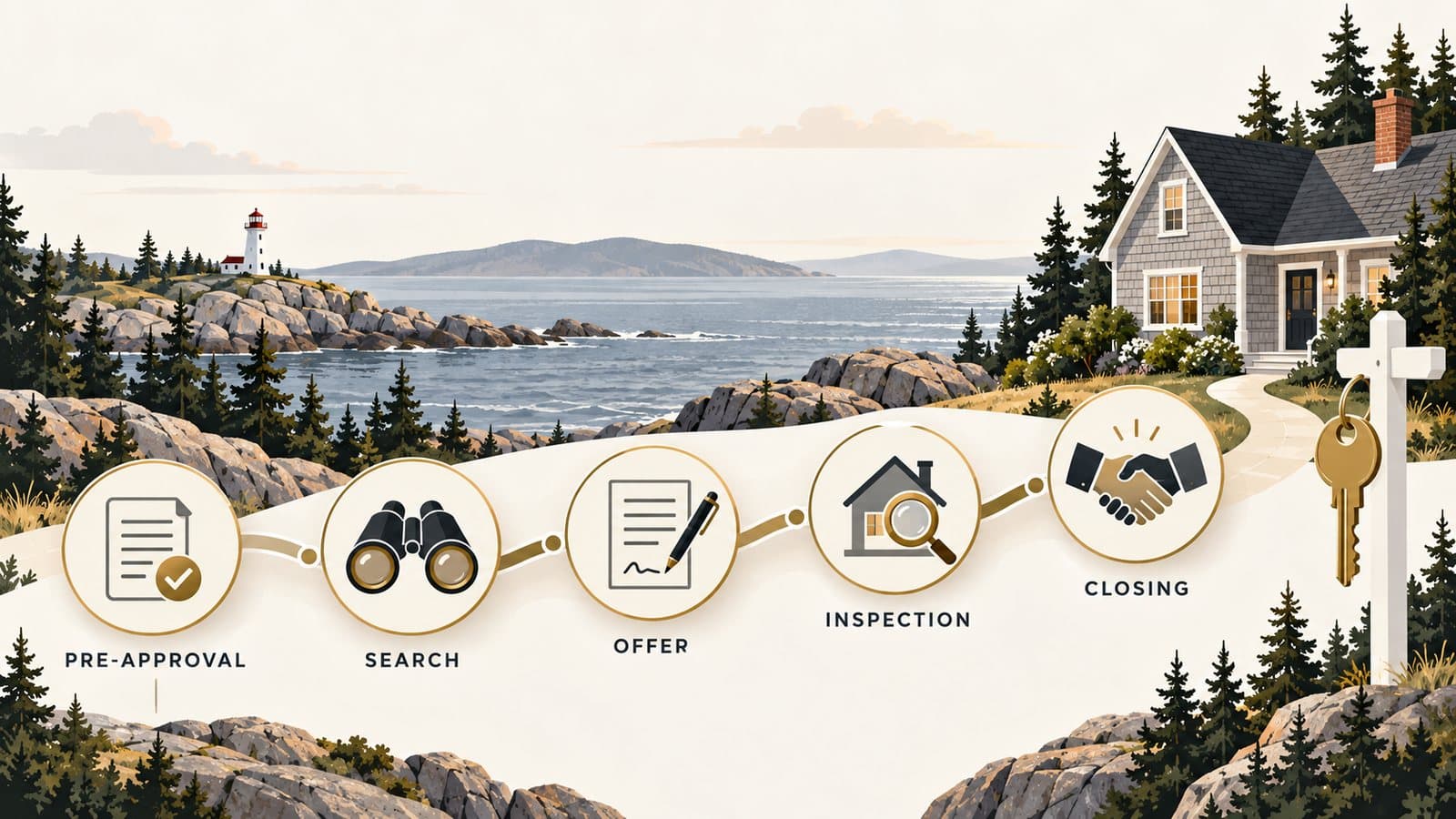
In Nova Scotia, the standard purchase process works like this:
- Submit an Agreement of Purchase and Sale — Your agent drafts this
- Include conditions — Typically financing, home inspection, and sometimes insurance
- Deposit — Usually $5,000–$10,000, held in trust
- Condition period — 7-14 days to satisfy your conditions
- Condition removal — The deal becomes firm
- Closing — Typically 30-60 days after acceptance
Important Nova Scotia-Specific Notes
- Deed Transfer Tax: A municipal tax, and the rate varies by municipality. In Halifax Regional Municipality it is 1.5% of the purchase price, so $6,750 on a $450,000 home. Your lawyer will confirm the rate where you're buying.
- Property Disclosure Statement: Sellers are required to disclose known defects. Read this carefully.
- Well water and septic: Properties outside municipal services will require well water testing and septic inspection. Budget accordingly.
Step 6: After the Purchase
Once you've closed, a few important tasks:
- Register for property tax billing with your municipality
- Set up home insurance (required by your mortgage lender)
- Change your address with Canada Post, CRA, Nova Scotia Health, and your driver's license
- Meet your neighbours — seriously, community connection matters here
My Top Tips for First-Time Buyers
- Start with pre-approval, not house hunting. Know your number first.
- Don't max out your budget. Leave room for life's surprises.
- Older homes have character—and costs. Budget for upgrades and repairs.
- Visit neighbourhoods at different times. A Saturday afternoon and a Tuesday evening give very different impressions.
- Trust the inspection. If it reveals serious issues, it's okay to walk away.
Buying your first home is a big deal, and you don't have to figure it out alone. If you're considering Nova Scotia, I'd love to help you find the right community and the right home. Let's start a conversation.